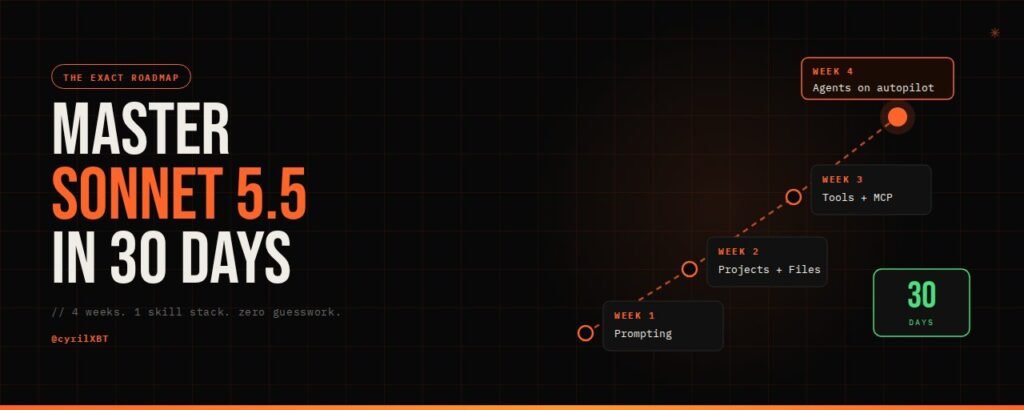
You don’t need 30 days to start using Sonnet 5.5 well, but you do need the habits this plan builds: writing a clear brief, giving the model the right context, and checking its work instead of regenerating. Those habits carry over to every model that comes next. If you only have time for one week of this plan, do Week 1. If you write code, add Week 2.
A personal note: I use Claude Pro myself, but I mostly choose Opus, not Sonnet, so I haven’t followed this plan with Sonnet 5.5 specifically. The features it leans on, Projects, file uploads, Research and connected apps, are ones I do use in my own work.
Updated 15 October 2026. Model facts come from Anthropic’s documentation and launch page; the 30-day plan is a suggested learning path I designed, not a programme I’ve run end to end, and I ran no benchmarks. Disclosure: Anthropic makes Sonnet 5.5, and Claude helped draft this guide.

Sonnet 5.5 at a Glance
| Item | Detail (per Anthropic) |
|---|---|
| Released | 28 September 2026 |
| API model ID | claude-sonnet-5-5 |
| Context / max output | 1M tokens / 128K tokens |
| Price | $2 per million input tokens, $10 per million output |
| Prompt caching | Reads $0.10 per million; writes $2.50 (5-minute) or $4 (1-hour) |
| Batch API | 50% off input and output |
| Thinking | Adaptive; API default effort is high, while Claude Code and the apps reportedly start at medium |
| Input / output | Text and images in, text out |
| Knowledge cutoff | June 2026 |
| Where | Claude apps, Claude API, Amazon Bedrock, Google Cloud, Microsoft Foundry |
Anthropic says it runs about 30% faster than Sonnet 5 and costs up to an estimated 30% less on typical workloads at the same per-token price, because it uses fewer tokens. US-only inference costs 1.1 times standard. For the full cost picture, see my Sonnet 5.5 pricing analysis.
Sonnet 5.5 or Opus 5.5?
Anthropic positions Sonnet 5.5 as the faster, cheaper complement to Opus 5.5 for “well-scoped everyday tasks”. My rule: start with Sonnet for coding, agents, documents, research and writing, and move to Opus only when a task has already defeated Sonnet more than once or needs long, multi-step reliability. In Claude Code the default on paid plans is still Opus 5.5; choose Sonnet with /model sonnet (Tododeia cites version 2.1.284 or later), or use opusplan, where Opus plans in plan mode and Sonnet executes.
Week 1: Foundations (Days 1–7)
Goal: stop treating it like a search box and start briefing it like a colleague.
- Day 1, context file. Create a Claude Project and spend 30 minutes on a short document about how you work:
ABOUT ME What I do / who for: Tools I use daily: What good work looks like: How I like answers: Things I never want: Current projects and goals: - Day 2, the five-part brief. Goal, context, input, constraints, and what “done” looks like. Run one real task with a one-line request and again with the full brief, and compare.
- Day 3, make it ask. “Before you start, ask me the 3 questions whose answers would most change the result. Wait for my answers.”
- Day 4, a reusable prompt. Pick a weekly task, write the process once, test it on three real examples, save it in Project instructions.
- Day 5, edit, don’t regenerate. “Keep everything except: 1) make section two more specific, 2) cut the last paragraph, 3) make the opening less formal.”
- Day 6, real files. Upload a messy spreadsheet, PDF or meeting notes; ask for a summary, the three key findings and one question the document doesn’t answer.
- Day 7, review. Give it six of your prompts and ask what each brief was missing.
Week 2: Build With It (Days 8–14)
- Day 8: install Claude Code (follow Anthropic’s current instructions) and ask it to build a small tool you’d really use, in one HTML file, then tell you what to test first.
- Day 9: write a short CLAUDE.md: what the project is, how to run it, rules it must never break. Keep it under about 200 lines; my Claude Code setup guide explains why.
- Day 10: fix a real bug, and watch how it forms and checks a hypothesis.
- Day 11: “Before changing anything, write tests that describe how this should behave. Run them, make the change, run them again.”
- Day 12: try computer use on a small, low-risk task, watching the first runs closely.
- Day 13: build something for another person; real users expose gaps fast.
- Day 14: note three things it did well and two where it got stuck. The stuck points usually reveal missing context.
Week 3: Agents and the API (Days 15–21)
Non-technical readers can do Days 15, 16 and 21 only.
- Day 15: list tasks you repeat weekly and ask which an agent could do fully, partly or not at all, what inputs it needs, what could go wrong and the likely time saved.
- Day 16: turn the best candidate into a saved brief with a predictable input and output.
- Day 17: first API call, with the model ID in an environment variable:
import os, anthropic client = anthropic.Anthropic() MODEL = os.environ["SONNET_MODEL"] # claude-sonnet-5-5 reply = client.messages.create( model=MODEL, max_tokens=2000, messages=[{"role": "user", "content": "Summarize this in 3 bullet points: ..."}], ) print(reply.content[0].text) - Day 18: turn on prompt caching for stable instructions:
system=[{"type": "text", "text": LONG_INSTRUCTIONS, "cache_control": {"type": "ephemeral"}}] - Day 19: give it one tightly scoped tool, such as reading a file. Add more only when that one is reliable.
- Day 20: match effort to the job: high for planning and hard debugging, low for formatting and classification.
- Day 21: add a human checkpoint before anything that sends, deletes, buys or publishes.
What Week 3 Will Cost: Our Calculation
Method: we costed a practice week of API calls at Anthropic’s list prices, checked on 15 October 2026 on its pricing page. This is arithmetic, not a measurement of your usage. We assumed 30 practice calls a day for seven days, each with about 5,000 input tokens (instructions, a tool definition and some context) and 1,000 output tokens. Thinking tokens are billed as output, so a high effort setting can raise the output figure considerably.
| Model | Per call | 210 calls (one week) | Same week, 4,000-token instructions cached |
|---|---|---|---|
| Claude Haiku 5.5 | $0.001 | about $0.21 | about $0.13 |
| Claude Sonnet 5.5 | $0.02 | about $4.20 | about $2.60 |
| Claude Opus 5.5 | $0.04 | about $8.40 | about $5.20 |
The cached column assumes the same 4,000-token block is read from cache at $0.10 per million on Sonnet ($0.01 on Haiku, $0.20 on Opus), ignoring small one-off write charges. A learning week on Sonnet costs a few dollars, so cost shouldn’t stop you; caching early saves real money once something runs daily. Set a monthly spending limit in the Claude Console first, so a bug in a loop can’t run up a bill.
Week 4: Ship Something Real (Days 22–30)
- Day 22: pick a small, useful project and ask for seven daily milestones, with the riskiest part early and “someone else uses it” on the last day.
- Days 23–27: one milestone a day. End each session with: “Summarise what we built, what’s broken, and the first thing to do tomorrow, under 150 words.”
- Day 28: measure time before, time after and running cost, using real Console figures.
- Day 29: watch someone use it without helping.
- Day 30: write up what you built, the numbers, what broke and what surprised you.
Habits That Change With Sonnet 5.5
- Five recalibrated effort levels (low, medium, high, extra-high, max). “High” isn’t what it was on Sonnet 5. In Claude Code thinking can’t be turned off, only adjusted with
/effort. - It may stop to ask on long tasks at low or medium effort, and at low effort may call something finished without testing it, or add tests or docs you didn’t ask for. Tell it to finish the whole task, list assumptions, run the checks and stay in scope.
- Curb premature building: PCWorld reports Anthropic’s prompting guide includes a prompt for this, best placed in custom instructions or CLAUDE.md.
- Ask for results, not reasoning: requests to write out internal reasoning can be declined. Ask for the result, the evidence and what it couldn’t verify.
- More bullets than Opus in multi-part chat answers; ask for prose if you prefer.
- Safety fallbacks: per Tododeia’s summary, Claude Code re-runs messages flagged as high-risk cybersecurity on Sonnet 5 (until you switch back with
/model) and declines flagged biology requests. Normal development isn’t affected. Switching accounts mid-session can also cause problems.
Benchmarks and Customer Claims, With Fine Print
Published by Anthropic at launch, reproduced from Tododeia’s breakdown. Some were run by third parties on pre-release versions.
| Benchmark | Measures | Sonnet 5.5 | Sonnet 5 | Opus 5.5 |
|---|---|---|---|---|
| Terminal-Bench 4.0 | Agentic coding in a terminal | 70.6% | 10.3% | 66.4% |
| CursorBench 4.0 | Coding in real Cursor sessions | 55.5% | 34.1% | 57.8% |
| OSWorld 2.1 | Computer use (partial) | 80.1% | 57.0% | 81.8% |
| Chartography | Reading charts without tools | 61.6% | 15.6% | 64.4% |
| Humanity’s Last Exam | Reasoning, with tools | 64.5% | 54.9% | 67.7% |
Sonnet beats Opus only on Terminal-Bench (against Opus’s extra-high result). More effort isn’t always better: on FrontierCode, Sonnet scored 46.2% at max effort against 52.1% at extra-high, because max more often triggered Claude Code’s multi-agent review, which twice ended in timeouts or extra edits.
Customer claims on Anthropic’s launch page (names shown as logos; Tododeia attributes them to Zendesk, Base44 and others, so treat names as secondhand): about 20% faster ticket handling on hundreds of real support cases; 3.6 iterations per app build against 7.7 across 118 builds; about 121,000 tokens per answer against 497,000 for Sonnet 5 on a finance team’s 2,441-task suite; and about 14% fewer output tokens with no prompt changes. I haven’t verified any of these. The lesson is to measure token counts on your own work rather than trust a headline percentage.
Limits to Keep in Mind
Anthropic’s own positioning is “well-scoped everyday tasks”, so very long jobs where errors compound may still justify Opus. The June 2026 knowledge cutoff means anything newer needs search or documents you supply, and some security-related requests face extra safeguards.
FAQ
How much does Sonnet 5.5 cost?
$2 per million input tokens and $10 per million output via the API, with 50% off through Batch and $0.10 per million for cache reads. Chat use is included in Claude plans.
What’s the context window?
1M tokens, with up to 128K tokens of output.
Do I need to code to follow this plan?
No. Weeks 1 and 4, plus Days 15, 16 and 21, need no code.
What’s the API model ID?
claude-sonnet-5-5.
Related: Sonnet 5.5 pricing and speed · Claude Haiku 5.5 explained · Claude vs ChatGPT for coding · AI tool pricing compared