
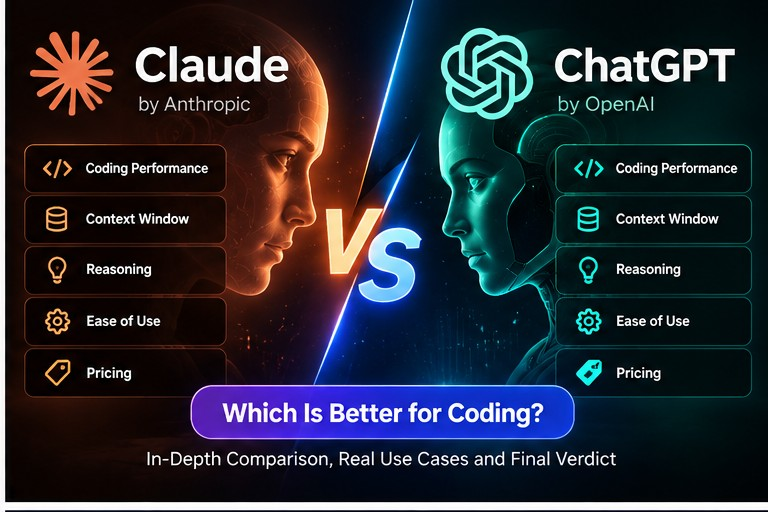
Ask two AI assistants to explain a short Python function and you’ll get two convincing answers. That tells you very little about which one will help when your tests are failing, your dependencies are out of date and the bug only appears in production. So I won’t judge Claude and ChatGPT on chat answers. What matters for coding in 2026 is the agent around each model: Claude Code on one side, Codex on the other.
Live prices and outages: current plan prices, whether each service is up right now and how many incidents its provider posted in the last 30 days are on our Claude and ChatGPT pages, with status checked every 10 minutes. The open-source Codex CLI has its own maintenance page too.
To be clear about my own bias: I code with Claude, mostly WordPress sites and HTML and CSS. I haven’t coded in ChatGPT itself, but I have tried OpenAI’s Codex, and for the kind of work I do, Claude suited me better. That’s a small sample, so the rest of this comparison is built on documentation and public repositories rather than my preference.
My verdict, up front: if I had to pick one for working inside a real repository today, I’d start with Claude Code. The published benchmarks lean its way, and it’s by far the most visibly credited coding assistant in the public projects I checked. I’d pick Codex instead if you already pay for ChatGPT Plus, or if you want an agent whose source you can read and audit, because Codex CLI is open source and Claude Code isn’t. Both cost $20 a month to start, so the honest tie-breaker is a test on your own code.
Disclosure: Claude is made by Anthropic, which also makes the AI assistant I use to help research and draft this site. I’ve tried to keep that from tilting the comparison; every figure below is sourced or measured, and you should check the vendors’ own pages. I haven’t run a controlled head-to-head test of the two agents.
What Each Setup Costs and Runs On
| Item | Claude Code | ChatGPT (Codex) |
|---|---|---|
| How you get it | Included in paid Claude plans (not on Free) | Codex and ChatGPT Work included across ChatGPT plans, with shared usage |
| Entry paid plan | Pro, $20 a month ($17 billed annually) | Plus, $20 a month |
| Heavier use | Max, $100 or $200 a month | Pro, from $100 a month |
| How limits work | Rolling five-hour window plus weekly caps | Message and credit limits that depend on plan and model |
| Top coding models | Claude Opus 5.5 and Sonnet 5.5 | OpenAI’s GPT-6 family, including GPT-6.1 Sol in Work and Codex |
| API list price per million tokens (input / output) | Sonnet 5.5: $2 / $10; Opus 5.5: $4 / $20 | GPT-6.1 Sol: $2 / $10; GPT-6 Astra: $10 / $50 |
| Source code | Closed (the public repository holds the changelog, plugins and built-in mods) | Codex CLI is open source, Apache 2.0 |
Claude prices are from Anthropic’s pricing page; API prices for OpenAI are as tabulated by VentureBeat on 13 October 2026. Subscriptions and API usage are billed separately with both vendors.
What the Published Numbers Say
- Vendor benchmarks. Anthropic’s launch table puts Sonnet 5.5 at 70.6% on Terminal-Bench 4.0, ahead of Opus 5.5 at 66.4%. In Google’s table for its Gemini 4 Argon launch, DeepSWE v1.1 shows Opus 5.5 at 74.2% and GPT-6 Astra at 74.1%, effectively a tie. These are company-reported figures on different tests and settings.
- An independent aggregate. Artificial Analysis’s Intelligence Index, as reported by VentureBeat, scores Claude Opus 5.5 at 58 and Sonnet 5.5 at 56, against 53 for GPT-6 Astra. That’s a general index, not a coding benchmark, but it points the same way.
- The reference points. A tester quoted by VentureBeat said he doesn’t think Google’s Antigravity is close to Claude Code or Codex for autonomous software engineering. In other words, these two are the agents everyone else is measured against.
Taken together, that’s a modest lead for Claude, not a knockout. A two-point benchmark gap disappears quickly if one agent understands your codebase’s conventions better than the other.
What I Measured in Public Repositories
Method: on 15 October 2026 we cloned 22 public GitHub repositories (including n8n, VS Code, React, Next.js, Dify, CrewAI and the official Codex and Claude Code repositories) and read the commit history for the previous 90 days. The analysis was scripted with AI assistance and spot-checked by hand. We did not run either tool on a coding task.
| What we measured (last 90 days) | Claude | OpenAI Codex |
|---|---|---|
| Commit co-author lines naming the tool, across 22 repositories | 2,299 | 61 |
| Repositories where it was credited at least once | 13 | 4 |
| Product releases | 74 Claude Code changelog versions | 35 stable Codex CLI releases |
The co-author gap looks dramatic, and I’d be careful with it. Claude Code adds a “Co-authored-by” line to commits by default; I don’t believe Codex does in every workflow. OpenAI’s own Codex repository, with 3,990 commits in the period, had no AI co-author lines at all, which says more about its conventions than about whether its engineers use Codex. What the table does show is that Claude is the most visibly credited assistant in widely used projects. It doesn’t show it’s used 37 times more.
The release numbers are easier to compare: both ship several times a week. Whichever you standardise on, pin the version and read the release notes before upgrading.
The Test That Actually Decides It
Benchmarks and commit counts narrow the field. Your own code decides. Here’s the test I’d run, and recommend you run, in an afternoon. It’s a procedure, not a result I’m reporting.
Create a disposable repository with an orders table, an idempotency-key field and a simulated payment callback. Before involving any AI, write three tests: two sequential requests with the same key create one order; two concurrent requests with the same key create one order; and a failed payment retry doesn’t mark an unpaid order as paid. Then give both agents the same repository and prompt:
“Fix the duplicate-order failure without changing the public API. Explain the transaction boundary, add regression tests and show the smallest reviewable diff.”
Score each on passing tests, files changed, new security risks, follow-up prompts needed and minutes of your own review. A good agent will talk about retries, where idempotency keys are stored, transaction scope and what happens when two workers grab the same key. A weak one will add a uniqueness constraint and call it done.
Habits That Matter More Than the Brand
- Give the right context, not all of it. The failing function, its callers, dependency versions, config and tests beat pasting the whole repository.
- Ask for a plan before a patch on any refactor that touches shared interfaces, and be suspicious of diffs that rewrite unrelated files.
- Check permissions before letting either agent run commands in a repository that matters.
- Check data terms for company code. Consumer chat plans and business or API offerings don’t always share the same retention and training rules.
What Others Found
Other publishers’ observations, summarised in my words. Built In’s May 2026 comparison ran Claude Code, Codex, Cursor and Copilot through a test-driven loop and found that plausible-looking code still often needed real debugging, which is why I weight test results and review time over demos. Zapier’s 2026 comparison separates Claude Code from Codex for the same reason I do: comparing two chat windows doesn’t measure either agent. And a 2026 preprint analysing 7,156 AI-agent pull requests found acceptance varied a lot by task type, with documentation changes accepted more often than new features. Test the kind of work you actually do.
Who Should Pick Which
| If you… | I’d pick |
|---|---|
| Do heavy multi-file work and live in the terminal | Claude Code |
| Already pay for ChatGPT Plus | Codex first; it costs you nothing extra |
| Need to audit or customise the agent itself | Codex CLI (open source) |
| Already pay for Claude Pro | Claude Code first |
| Can’t decide | Run the duplicate-order test above on both. One afternoon beats any article, including this one. |
A confident answer that fails your tests is still a bad answer, whichever logo is on it.
FAQ
Is Claude better than ChatGPT for Python?
The published numbers lean slightly towards Claude, but it depends on the task, model version and tools. Try the same Python bug and tests with both.
Can I use one assistant to review the other’s code?
Yes, a second pass catches things. But two agreeing assistants aren’t a substitute for tests, security checks and your own review.
Related: Claude Code vs Cursor · Best AI coding tools in 2026 · AI tool pricing compared
More from EvalAITools: A 30-day plan for Claude Sonnet 5.5 · Open-weight coding models compared · Claude Code setup guide
Sources (checked 15 October 2026)
- Claude pricing (Anthropic)
- ChatGPT Work and Codex pricing (OpenAI, excerpt only)
- VentureBeat: Google makes Gemini 4 Argon broadly available (13 October 2026)
- AI Coding Tools Pricing Comparison 2026 (Developers Digest)
- Built In: Claude Code, Codex, Cursor and GitHub Copilot compared (May 2026)
- Zapier: Claude vs ChatGPT (2026)
- Preprint: analysis of 7,156 AI-agent pull requests (2026)
- Public GitHub repositories listed in the method note, checked 15 October 2026



2 comments